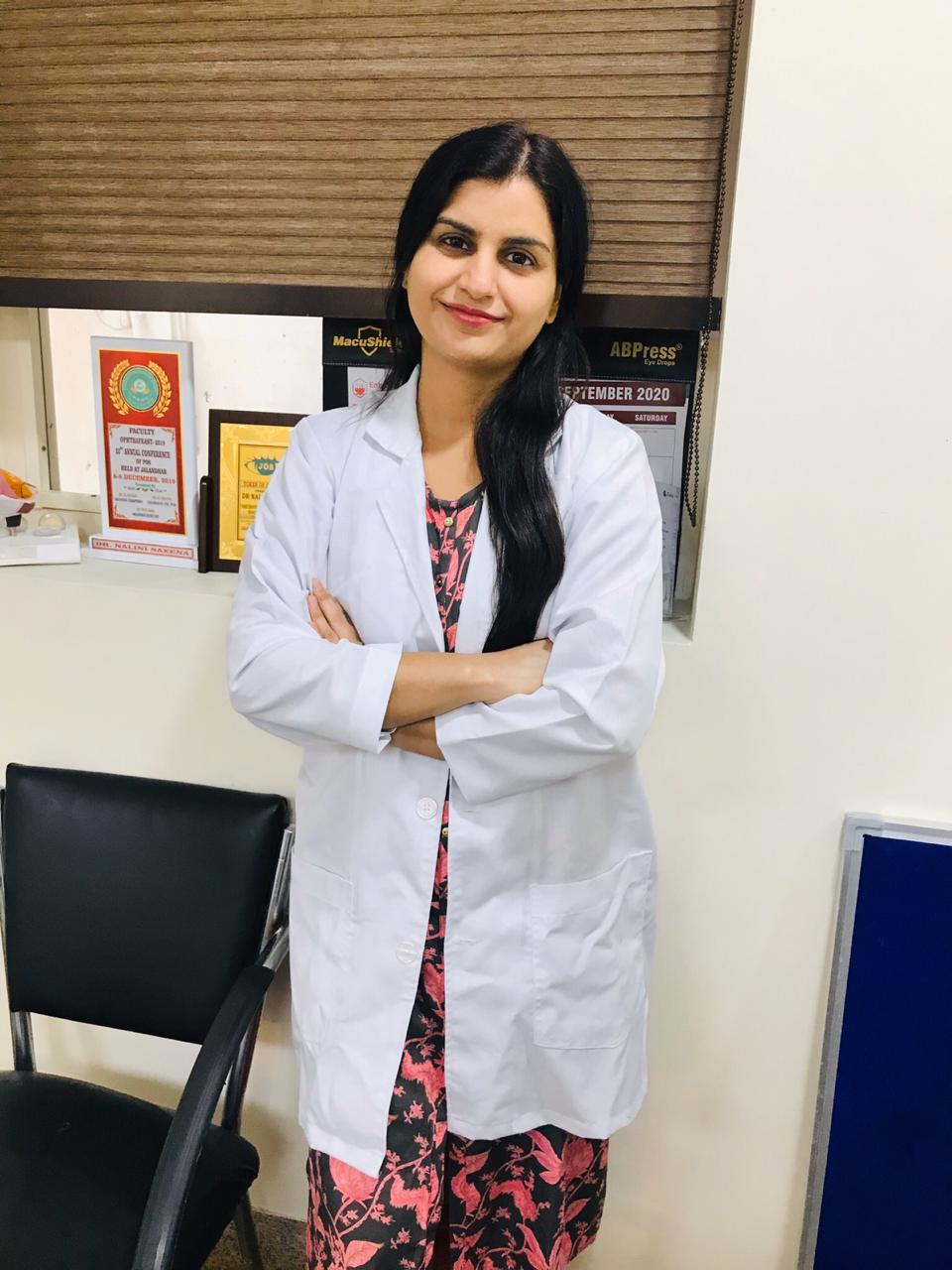
Not every eye doctor treats the retina. The retina is the delicate layer at the back of the eye, and its diseases need a doctor with extra training called a vitreo-retinal specialist. Dr Nalini Saxena is one such specialist in Jalandhar. After her MS in Ophthalmology from Maulana Azad Medical College, she completed a dedicated fellowship in vitreo-retinal disease management at Venu Eye Institute and Research Centre, New Delhi, followed by two months of advanced training in complex vitreo-retinal surgery in Germany.
At Drishti Eye Care & Retina Centre, Lambra, she offers the full range of retina care: examination, eye injections and stitchless retinal surgery.
Need a retina opinion in Jalandhar?
Floaters, flashes, a shadow in your vision, or a referral from your eye doctor — book a retina examination with Dr Nalini Saxena. Call or WhatsApp us.
What is the retina, and what can go wrong?
Think of the eye as a camera. The front of the eye (cornea and lens) is the camera lens. The retina is the film at the back. It turns light into signals that go to the brain through the optic nerve. The centre of the retina, the macula, gives you sharp reading vision. In front of the retina is a clear jelly called the vitreous. “Vitreo-retinal” simply means the jelly and the retina together.
If the front of the eye is cloudy — for example a cataract — surgery can clear it. But if the film is damaged, a clear lens does not help. This is why retinal problems need to be found and treated early. Common retinal diseases we treat include:
- Diabetic retinopathy — damage to retinal blood vessels from diabetes. The most common retinal problem we see in Jalandhar.
- Retinal detachment — the retina peels away from the wall of the eye. An emergency.
- Age-related macular degeneration — wearing out of the macula in older people, causing blurred or distorted central vision.
- Retinal vein occlusion — a “stroke” in a retinal vein that causes swelling and bleeding.
- Macular hole and macular pucker — a small hole or a wrinkle at the centre of the retina.
- Retinopathy of prematurity — a retinal disease of premature babies. See our ROP screening page.
- Dislocated lens or lens implant — when the natural lens or an artificial lens slips backwards into the eye.
Symptoms of retinal disease
Retinal problems usually do not cause pain. The eye looks normal from outside. What changes is what you see:
- New floaters — black dots, threads or cobwebs that drift across your vision
- Flashes of light, like lightning, especially in the side of your vision
- A dark shadow or curtain coming across the vision from any side
- Straight lines (door frames, tiles, lines on paper) appearing wavy or bent
- A blurred or missing patch in the centre of your vision
- Sudden, painless loss of vision in one eye
- Vision that is worse in dim light
When to see a retina specialist
See a retina specialist the same day if you have a sudden shower of floaters, flashes, or a curtain over your vision. These can be signs of a retinal tear or detachment, and the earlier it is repaired, the better the vision that can be saved.
Book a routine retina examination if you have diabetes (every year), if you are very short-sighted (high minus number), if you are over 60 and notice distortion, or if you have had an eye injury. Your family doctor or optician may also refer you after seeing changes at the back of your eye.
Untreated retinal damage can become permanent within days to weeks. If you are not sure whether your symptom is serious, call us. It is always better to be checked.
How Dr Nalini treats retinal diseases
Dr Nalini Saxena treats both medical and surgical retinal disease. She has also passed the examination of the Royal College of Surgeons, has research publications in national and international journals, and has presented at international meetings such as the World Ophthalmology Congress and EURETINA, the European retina society.
Medical retina
Many retinal diseases are treated without surgery. Intra-vitreal injections are medicines injected into the jelly of the eye with a very fine needle after numbing drops. They are used for diabetic swelling, vein occlusion and wet macular degeneration. Scans of the retina show whether the swelling is going down.
Surgical retina
When the problem is mechanical — a detachment, a hole, scar tissue, blood that will not clear, or a dislocated lens — surgery is needed. Dr Nalini performs stitchless vitreo-retinal surgery through openings smaller than a millimetre. The jelly is removed, the retina is repaired, and a gas or oil bubble may be placed inside the eye to hold the retina in position while it heals. Because the openings are so small, stitches are usually not needed.
She also performs scleral fixation of IOL: when a lens implant has no natural support, or has slipped backwards, it is fixed to the wall of the eye (the sclera). Because she is also an experienced cataract surgeon, front and back-of-the-eye problems can be handled in a single surgery when needed.
What to expect on the day
A retina examination is longer than a normal eye test. Your vision and eye pressure are checked, then drops are put in to widen the pupils, which takes about 30 minutes. Dr Nalini then examines the retina with a bright light and a lens, and scans may be taken. Your vision stays blurry for a few hours, so bring someone with you.
If an injection is needed, it can often be done on the same visit. Surgery is planned as a daycare procedure under local anaesthesia in most patients.
Recovery
- Examination: blurry vision for a few hours from the dilating drops, then back to normal.
- Injection: normal activities the next day. Mild redness or a few floaters for a day or two is expected. Use the antibiotic drops as advised.
- Surgery: vision is blurry at first and clears over weeks. If a gas bubble was used, you will see a dark ball in your vision that shrinks over days to weeks, and you must not fly or travel to high altitude until it is gone. You may be asked to keep your head in a particular position. Follow the drop schedule and come for all follow-up visits.
Cost of retina treatment in Jalandhar
Because “retina treatment” covers everything from a check-up to a complex surgery, cost varies widely. The main factors are:
- Examination and scans — the type and number of scans needed.
- Injections — the medicine used and the number of injections in the course.
- Surgery — the complexity of the case, whether gas or silicone oil is used, whether a lens fixation or cataract surgery is combined, and whether a second surgery is needed to remove oil later.
You receive a written estimate after the examination. Ask our staff about insurance and government scheme paperwork.
Frequently asked questions
Book a retina examination
Dr Nalini Saxena sees retina patients Mon to Sat, 10 AM to 6 PM, at Drishti Eye Care & Retina Centre, Lambra, Jalandhar.